


Weaver vs. Picatinny vs. Dovetail Rails: What’s the Difference?
If you’re new to shooting and you’ve stared at the top rail of a rifle wondering, “Which mounts fit this thing?” — relax, you’re not the only one. Let’s break this down so you can confidently choose the right base or rings.
What is a “Rail” Anyway?
Think of the rail as the parking lot where your scope or red dot sits. You want a surface that holds your optic steady, keeps your zero, and doesn’t wiggle when you pull the trigger. The rail system defines how your mounting hardware engages the firearm. The most common ones you’ll bump into are:
- The Weaver rail
- The Picatinny (MIL-STD-1913) rail
- The dovetail rail (11 mm / 3⁄8″)
They might look alike at first glance — but the devil’s in the details.
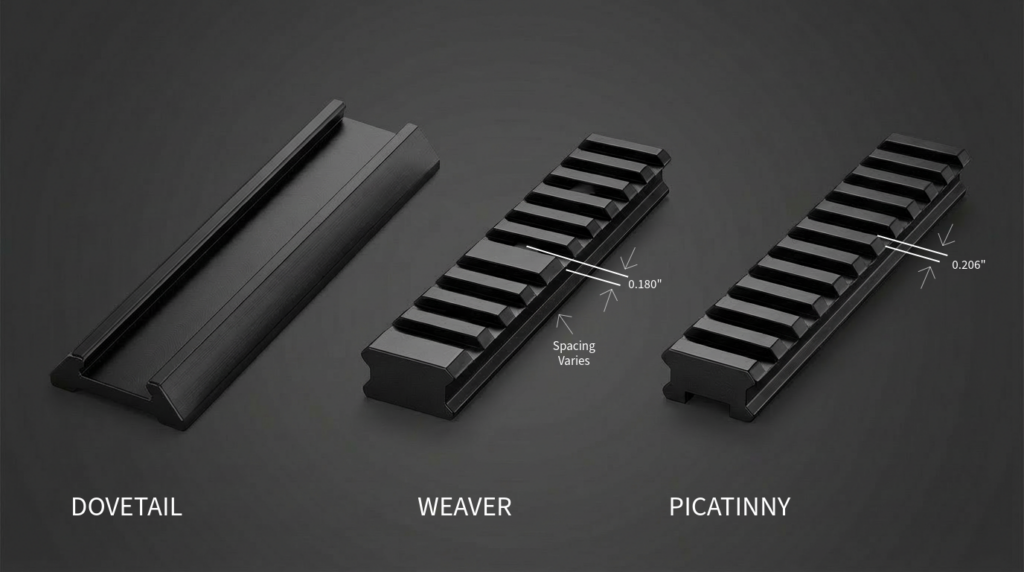
Weaver Rails: The Classic Hunting Buddy
The Weaver rail system has been around for a long time, especially on traditional hunting rifles. Here’s the gist:
- Slot (groove) width ≈ 0.180” (~4.57 mm)
- Slot spacing is not standard: spacing varies by manufacturer and model.
- Usually fewer cross-slots, sometimes just a couple, not a continuous row.
Here’s what that means: if your mount or rings are made for Weaver, they’ll fit a Weaver rail fine. But you might run into trouble if you assume every slot is spaced evenly — with Weaver rails that spacing can vary. Eye relief positioning might be less flexible.
Also: since many traditional rifles are set up this way, you’ll see plenty of Weaver-compatible bases and rings (including by the name brand Weaver). If you’ve got a hunting rifle and want something lightweight and straightforward — Weaver style makes sense.
Picatinny Rails: the Modern Standard
Now let’s talk about the big player: the Picatinny rail (also called MIL-STD-1913). This system was built for consistent performance, modular accessories, and repeatable mounting. Key specs:
- Slot width ~ 0.206” (~5.23 mm)
- Slot center-to-center spacing exactly ~ 0.394” (~10.01 mm)
- Slots run along nearly the full length of the rail, giving more mounting positions.
Why the difference matters? Because accessories (rings, bases, lights, etc.) made for Picatinny assume that slot width and spacing. If you try to use a Picatinny-specific mount on a Weaver rail, the wider lug or the fixed spacing might not match up — meaning you might not get a secure fit.
One rule of thumb: Weaver accessories generally fit Picatinny rails but Picatinny accessories often won’t fit Weaver rails, because the slot is too narrow or the spacing doesn’t match.
Dovetail Rails: The Different Track
11 mm or 3⁄8″ dovetail rails are common on rimfire rifles (.22), airguns, and some lighter rifle platforms. Key characteristics:
- Rather than a row of cross-slots, you often get a continuous dovetail rail: just two angled surfaces and no standardized slot pattern.
- Common sizes: ~11 mm and ~3⁄8″ (~9.5 mm) dovetail.
- Rings clamp onto the dovetail surfaces, typically without a recoil-lug cross-slot engagement like Weaver/Picatinny.
What does this mean for you? If you’re mounting a scope on a rimfire or airgun and your base is dovetail-type, you’ll need rings made for that size (or an adapter). If you try to shove a Picatinny or Weaver ring onto a dovetail without proper adapter — you might get poor alignment, poor fit, or none at all.
How to Navigate Compatibility
So you’re building a rifle or buying a mount, and you’re thinking “What fits what?” Here’s a quick check-list:
- What rail is on your firearm?
- Does it have evenly spaced cross-slots of consistent size → likely Picatinny.
- Does it have just a few slots, narrower width, uneven spacing → likely Weaver.
- No cross-slots, just continuous angled rail surfaces → likely dovetail (11 mm or 3⁄8″).
- Does it have evenly spaced cross-slots of consistent size → likely Picatinny.
- What mount or ring are you buying?
- If you’re buying “Picatinny only,” beware if your firearm is Weaver.
- If your mount says “Weaver compatible,” you’re safer across both Weaver and Picatinny (in many cases).
- If you’re on dovetail, look for dovetail-specific rings or an adapter that converts dovetail to Weaver/Picatinny.
- If you’re buying “Picatinny only,” beware if your firearm is Weaver.
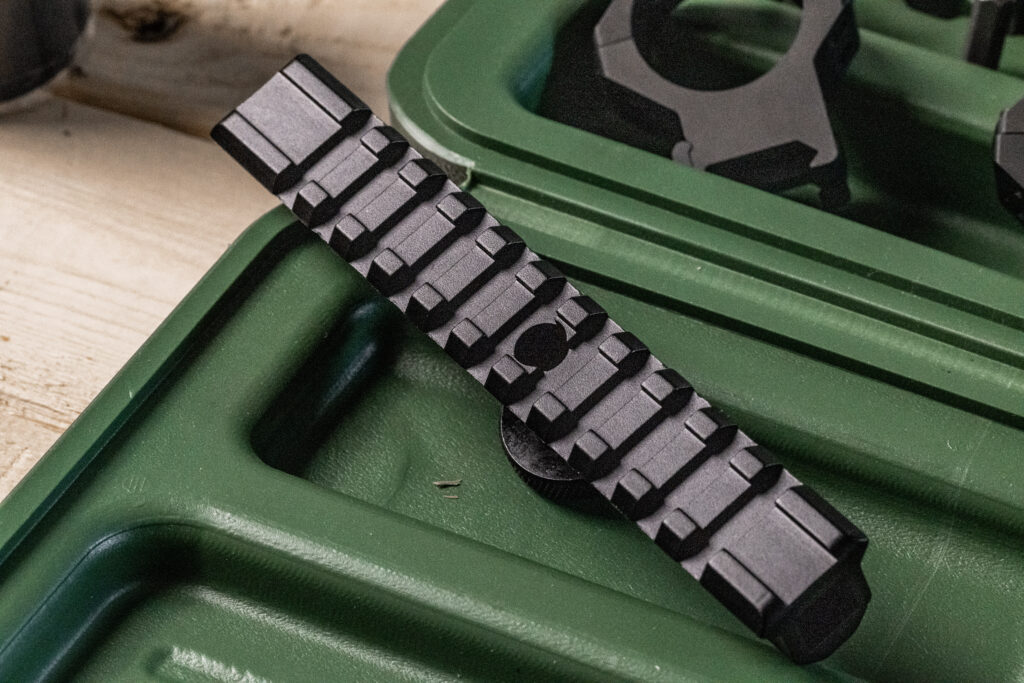
And yes — brand-specific adapters exist. For instance, if you’ve got a dovetail rail and want to use your existing Weaver/Picatinny rings, you can look for a Weaver dovetail-to-Weaver/Picatinny adapter. That gives you a flat platform that accepts standard rings, making your gear choices broader.
Which Rail Should You Pick?
If you’re starting fresh:
- For modern rifles, tactical setups, lots of accessories: go Picatinny.
- For traditional hunting rifles, lightweight or older style platforms: Weaver is still good.
- For rimfire/airgun or budget setups: you’ll often see dovetail — just know you may need to buy rings or adapters accordingly.
If flexibility matters and you want to future-proof your gear: Picatinny gives you the broadest accessory compatibility. But if you already own Weaver-style gear, that doesn’t mean you’re stuck — just check mount compatibility.
Final Thoughts
Mounting rails might feel like a small detail, but they’re the foundation of your optics setup. Get the rail-to-mount right, and everything else flows: proper eye relief, stable zero, less hassle at the range. Get it wrong, and you’ll spend time troubleshooting instead of shooting.
If you’re ready to equip your rifle with the right base, check out our Weaver Multislot Bases, Weaver Scope Rings, or our Dovetail-to-Weaver/Picatinny Adapters — we’ve built them with this compatibility stuff in mind.
Happy shooting — may your zero hold and your days at the range be smooth.