


Threadlocker: The Small Detail That Makes A Big Difference.
You've torqued your rings, your base is tight, and everything feels solid. But will it stay that way after fifty rounds of hard shooting? That's where threadlocker comes in. A small dab of the right compound in the right place adds another layer of security against vibration and recoil — but use it wrong and you'll create problems that are harder to fix than the one you were trying to prevent. Here's everything you need to know.
First, Know Your Screws
Before you crack open any threadlocker, it's important to understand that not all screws in your mounting system are the same — and they don't all get treated the same way. The two main categories are base screws and ring screws, and mixing up their torque specs or threadlocker treatment is one of the most common installation mistakes shooters make.
High Force, More Exposure To Recoil
Base Screws
Base screws attach your mount or rail adapter directly to the rifle's action. They absorb the full force of recoil with every shot and are the screws most likely to vibrate loose over time. These are typically larger fasteners — 6-48 or 8-40 on Weaver and Picatinny systems — and they're torqued to higher values than ring screws.
Weaver specs typically call for 15–18 in-lbs on 6-48 screws and 18–20 in-lbs on 8-40 screws — but always verify against your specific mount's manual, as specs vary by model. These are the screws where a small drop of blue threadlocker makes the most sense.
Small, Delicate, Easy To Damage
Ring Cap Screws
Ring cap screws are the small fasteners that clamp the ring halves together around your scope tube. They're smaller, more delicate, and much easier to damage through over-tightening. These typically run around 15 in-lbs on the cap screws — significantly less than base screws.
Many ring designs also have crossbolts that clamp the ring body to the base — these often call for higher torque around 30 in-lbs. Know which screw is which before you start tightening. Always check the manual for your exact ring model.
Threadlocker 101: Blue, Red, And Purple
Not all threadlocker is the same. The color tells you the strength — and for scope mounting, getting this right is critical. Here's what each type does and where it belongs.
Blue
Medium
Blue (Medium-Strength) Threadlocker
RecommendedThe standard choice for firearms applications. Blue threadlocker — like Loctite 242 or 243, or Weaver's own SureThread — cures to a medium-strength bond that resists vibration and recoil effectively while remaining removable with normal hand tools when needed. A small dab on base screws is smart insurance, especially on rifles that see heavy shooting or high-recoil loads. Some shooters also use it sparingly on ring cap screws for big calibers — just be aware that it reduces thread friction, so you may reach your torque spec at a lower wrench reading than usual. Don't compensate by tightening more.
Red
Permanent
Red (High-Strength) Threadlocker
Never On Scope HardwareRed threadlocker is essentially permanent. Once cured, it requires heat or special solvents to break the bond — and even then, you risk damaging the receiver or mount in the process. There is no scenario in scope mounting where red threadlocker is the right call. If you ever need to remove or adjust your scope, swap rings, or clean the receiver threads, red Loctite will turn a routine job into a frustrating ordeal. Keep it away from anything scope-related, full stop.
Purple
Low Strength
Purple / Green (Low-Strength) Threadlocker
OptionalLow-strength threadlocker (like Permatex Purple #222) acts almost like a thin tape — it prevents loosening from vibration but undoes easily by hand. It's safe for delicate parts and won't risk stripping anything. Perfectly acceptable for light-recoil setups or for shooters who want minimal holding power. If you're unsure which strength to use, blue is the standard recommendation for rifle scope mounting — it's strong enough for heavy recoil without sacrificing the ability to make adjustments later.
Where To Use It — At A Glance
| Location | Use Threadlocker? | Which Type | Notes |
|---|---|---|---|
| Base screws (mount to receiver) | Yes | Blue only | Most important location — these see the most recoil stress and are most likely to vibrate loose |
| Ring cap screws (light recoil) | Optional | Blue, sparingly | Often unnecessary on .22 or light centerfire. Proper torque is usually sufficient |
| Ring cap screws (heavy recoil) | Optional | Blue, tiny amount | A small dot can help on magnums — but remember it lowers friction, affecting torque feel |
| Ring crossbolts (to base) | Optional | Blue only | Check your ring's manual — some manufacturers advise against threadlocker here |
| Red threadlocker anywhere | Never | N/A | Permanent bond makes future removal extremely difficult without risk of damage |
Weaver's Solution: SureThread Adhesive
Weaver's SureThread is a medium-strength threadlocking adhesive engineered specifically with firearms mounting applications in mind. It hits the exact balance that scope mounting demands — strong enough to resist vibration and recoil over thousands of rounds, but removable with standard tools when you need to make adjustments or swap components.
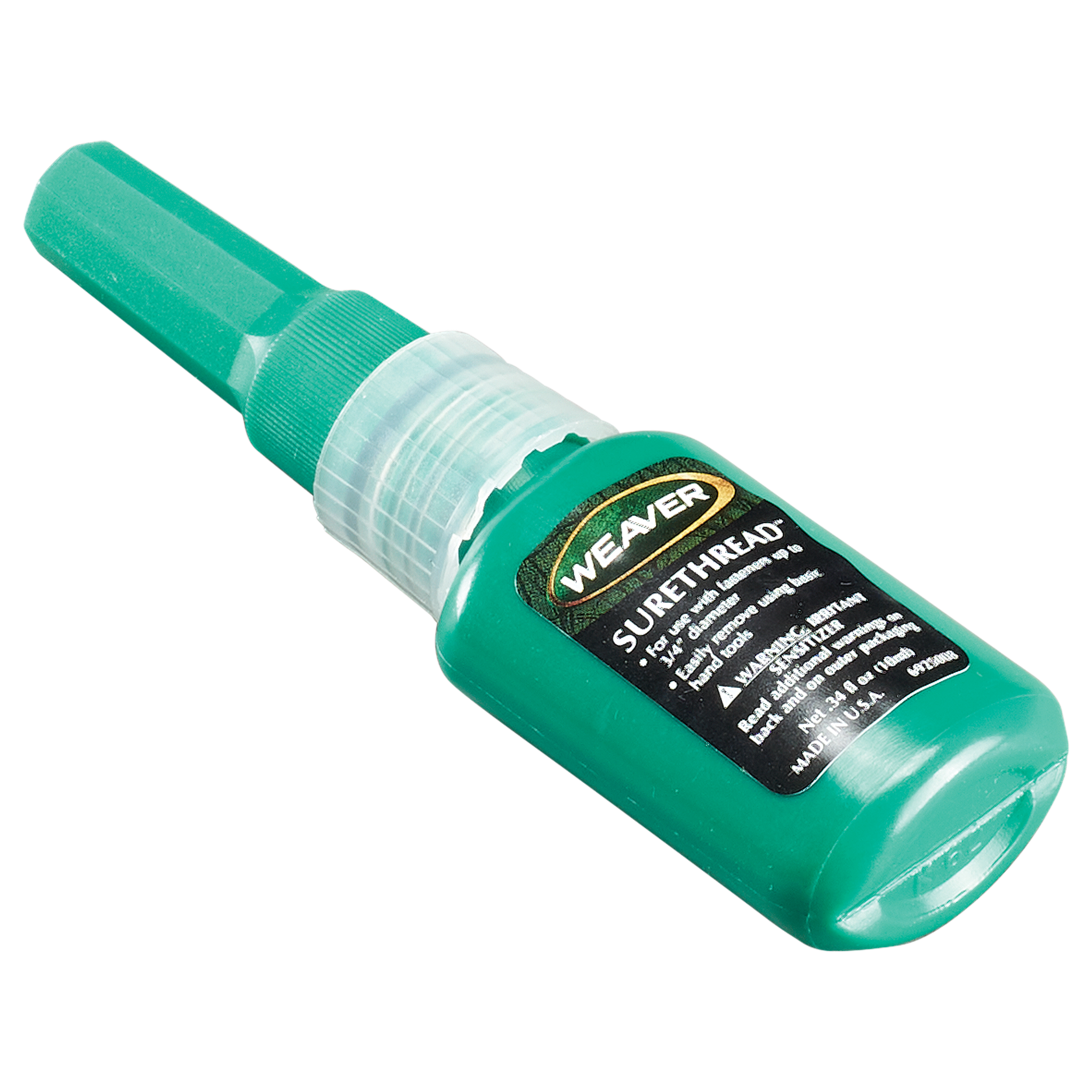
Medium-Strength Threadlocker
SureThread Adhesive
Designed for firearms applications, SureThread provides the holding power you need on base screws without the permanent bond of red Loctite. Apply a small amount to base screws before installation, torque to spec, and let it cure. Your mount stays put through heavy recoil, temperature changes, and repeated use — and comes apart cleanly with standard tools when you need it to. The right tool for the right job.
The Do's And Don'ts
Even with the right product in hand, how you apply threadlocker matters as much as where. Here's the full list of what to do — and what to avoid.
"Threadlocker Is A Tool — Not A Substitute For Proper Torque."
Used correctly, a small amount of blue threadlocker on the right screws adds genuine security to your mounting system without creating problems down the road.
Keep it simple: blue on base screws, torque wrench on everything, red threadlocker in the trash. Do that and your scope stays put through whatever you put the rifle through.