


Lost In The Lingo? Here's Your Plain-English Guide To Scope Mount Terms.
Getting into shooting sports can feel like learning a new language. Walk into any gun shop or hop on any forum and you'll hear terms like Picatinny, MOA, cantilever, and zero-stop thrown around like everyone just knows what they mean. This glossary is here to translate the most common scope mounting terms into plain English — so you can walk into any conversation, any shop, and any article on this site without feeling lost.
Jump To A Term
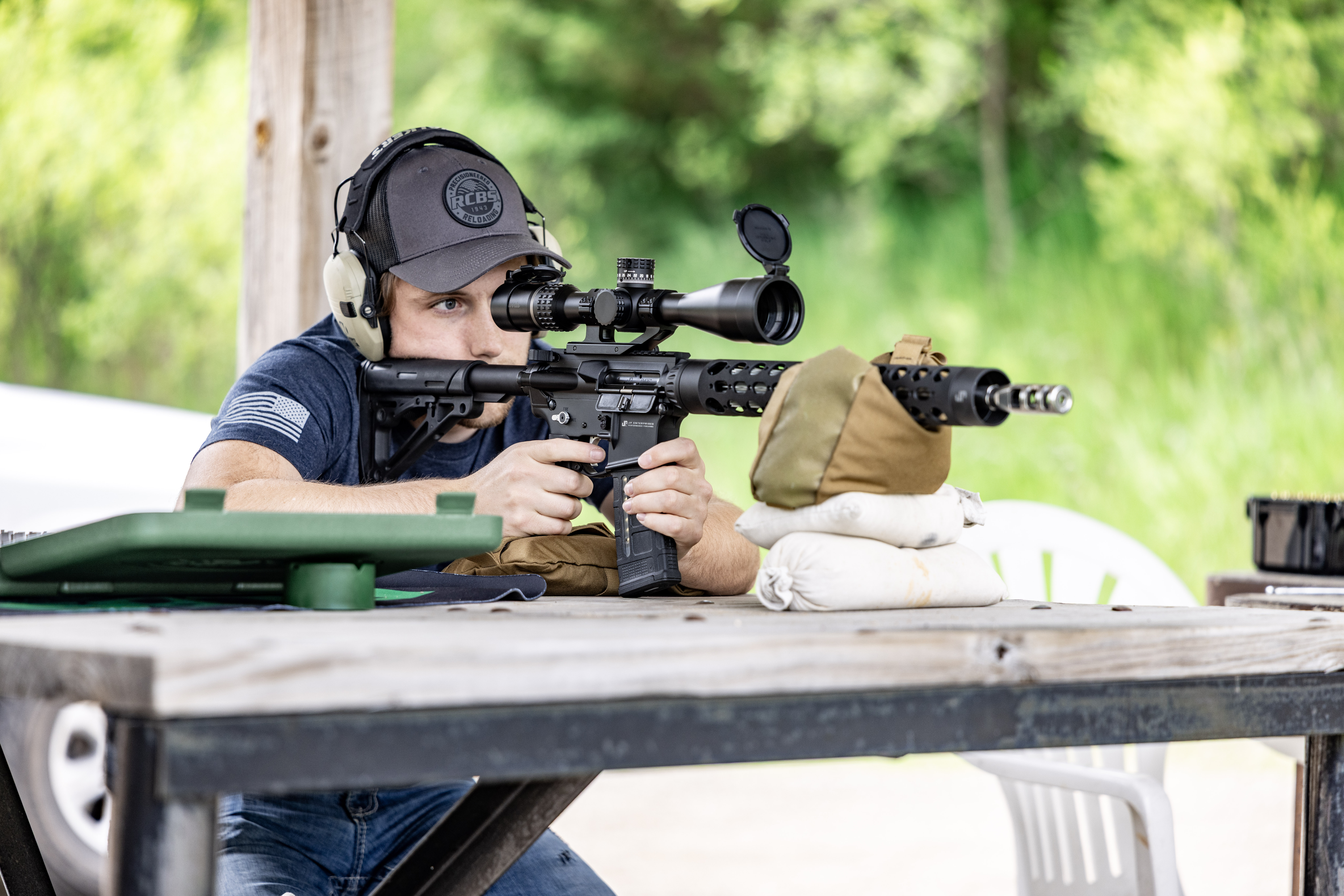
Every Term In This Guide Connects To Something On This Setup
Hardware — The Physical Parts
Bases & Rings
HardwareBases and rings are the two main components that physically connect your scope to your rifle. They work together as a system — you need both.
The base (or rail) attaches directly to the rifle's receiver using screws. It's the foundation. Some rifles come with a base or rail already installed at the factory. Others require you to install one yourself, either as a one-piece rail running the full length of the receiver or as a two-piece matched front-and-rear pair.
The rings are matched pairs (front and rear) that clamp around the scope tube and secure it to the base. They come in different heights — low, medium, and high — to accommodate scopes with different objective lens sizes. The right height is the lowest that allows the objective bell to clear the barrel without touching it.
Cantilever Mount
HardwareA cantilever mount is a one-piece mount where the rings extend forward beyond where the mount attaches to the rail. The rear of the mount clamps to the receiver, and the scope hangs out over the handguard and barrel area — like a diving board supported on one end only.
This design solves a specific problem: AR-15s and similar rifles have short top rails that don't leave enough room to position a scope with proper eye relief using standard rings. A cantilever mount pushes the scope forward automatically, giving you the extra inches of eye relief you need without any guesswork.
One-Piece Mount
HardwareA one-piece mount combines the base and rings into a single machined unit. Instead of separate components that have to be aligned to each other, everything is integrated — which means alignment is built in by the manufacturer rather than dependent on your installation.
One-piece mounts tend to be more rigid than two-piece setups because there are no joints or interfaces between the base and rings. That rigidity is particularly valuable on hard-kicking rifles or AR platforms where zero retention under recoil is a priority. The trade-off is less flexibility in ring spacing and generally higher cost than separate rings.
Rails — The Two Main Standards
Picatinny Rail
Rail SystemA Picatinny rail — also called a MIL-STD-1913 rail or "Pic rail" — is a standardized accessory mounting system developed for the U.S. military in 1995. It's the series of crosswise slots you see running along the top of most modern tactical and AR-style rifles.
The key word is standardized. Every Picatinny rail from every manufacturer is cut to the same dimensions — slots are 0.206 inches wide, spaced at exactly 0.394 inches center to center. That means any Picatinny-compatible accessory from any manufacturer will fit any Picatinny rail without compatibility questions.
Picatinny
Slot width: 0.206"
Spacing: Uniform, 0.394" center to center
Standard: MIL-STD-1913
Common on: AR-style, tactical, modern rifles
Weaver Rail
Slot width: 0.180"
Spacing: Variable — no fixed standard
Origin: William R. Weaver
Common on: Hunting rifles, older platforms
Weaver Rail
Rail SystemThe Weaver rail is the original standardized scope mounting system, invented by William R. Weaver decades before Picatinny existed. It uses crosswise slots — similar in appearance to Picatinny — but with slightly narrower slot width (0.180 inches) and no fixed spacing standard between slots.
Because the slot spacing varies by manufacturer, Weaver rails and accessories aren't always perfectly interchangeable the way Picatinny components are. However, many modern Weaver-compatible accessories are designed with enough flexibility to fit both Weaver and Picatinny rails. For decades, Weaver was the dominant standard on American hunting rifles, and countless rifles in the field still use Weaver-style bases today.
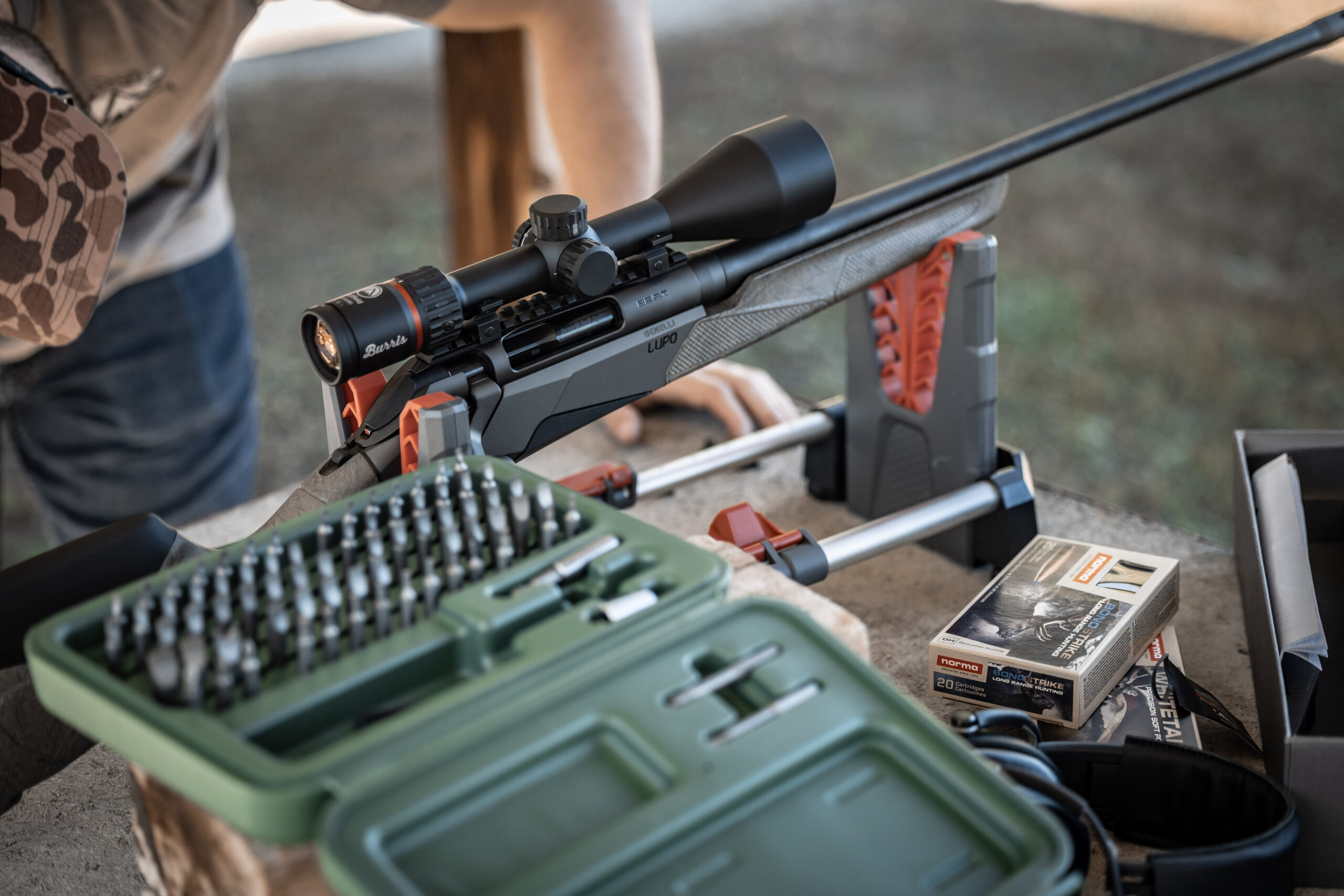
Understanding The Language Makes Every Part Of The Setup Make More Sense
Concepts — How Things Work
Bore-Sighting
ConceptBore-sighting is the process of roughly aligning your scope to your rifle's barrel before firing live rounds. It's a coarse adjustment — not a final zero — but it ensures your first shots at the range land somewhere on the paper rather than nowhere near the target.
On bolt-action rifles, you can literally remove the bolt and look through the barrel from the rear, centering a target in the bore's view, then adjusting the scope's reticle to match. For other action types, a laser boresighter achieves the same result by projecting a dot down the bore that you align the scope to.
Eye Relief
ConceptEye relief is the distance between your eye and the scope's rear lens where you can see the full, clear sight picture. Think of it as a sweet spot — too close and you see dark rings or a blurry image (and risk getting hit by the scope when the rifle recoils), too far and the image shrinks to a small circle.
Most rifle scopes have 3 to 4 inches of eye relief. When mounting a scope, you position it so that your eye naturally falls in that sweet spot every time you shoulder the rifle — without having to crane forward or lean back to find the image. Getting this right is a critical part of the mounting process, not an afterthought.
Torque
ConceptTorque is the measure of rotational force applied when tightening a screw — essentially, how tight you're fastening it. For scope mounts, torque is expressed in inch-pounds (in-lbs). Think of it like using a wrench: the twisting force you apply is the torque.
Getting torque right is one of the most important steps in scope mounting. Too loose and the scope can slip or shift under recoil, causing your zero to wander. Too tight and you risk stripping screws, crushing the scope tube, or warping the mount. Manufacturers publish specific torque specs for every screw in their mounting systems — follow them, and use a torque wrench rather than guessing by feel.
"Once You Know The Language, The Hardware Stops Being Intimidating."
Measurements — The Numbers Behind The Shots
MOA — Minute Of Angle
MeasurementMOA stands for Minute of Angle — a unit for measuring angles. One MOA is 1/60th of a degree. That's a tiny angle, but it translates into a real, measurable distance at the target depending on how far away the target is.
The rule of thumb: 1 MOA ≈ 1 inch at 100 yards. More precisely, it's 1.047 inches, but most shooters round to 1 inch for simplicity. That means 1 MOA = 2 inches at 200 yards, 5 inches at 500 yards, and 10 inches at 1,000 yards. The angle stays the same — the physical distance it represents grows with the range.
Scope turrets are typically calibrated in 1/4 MOA per click — meaning each click moves your point of impact approximately 0.25 inches at 100 yards. To move your group 1 inch at 100 yards, you need 4 clicks. At 200 yards, those same 4 clicks move impact 2 inches.
MIL — Milliradian
MeasurementMIL is short for milliradian — a different unit for measuring angles that's common in military and precision shooting communities. One MIL equals approximately 3.6 inches at 100 yards. Many scopes with MIL adjustments click in 0.1 MIL increments, which is about 0.36 inches at 100 yards per click.
There's an ongoing debate in the shooting world about MOA vs MIL. The honest answer: they're just two different units measuring the same thing. Neither is objectively better — it comes down to what system your scope is calibrated in and what you're used to working with. Most American hunters use MOA because it aligns conveniently with inches. Military and competition shooters often prefer MIL because the base-10 math is simpler for quick mental calculations.
MOA
1 MOA ≈ 1" at 100 yds
Typical click: 1/4 MOA (~0.25")
4 clicks = 1" at 100 yds
Good for: American hunters, intuitive inch math
MIL
1 MIL ≈ 3.6" at 100 yds
Typical click: 0.1 MIL (~0.36")
10 clicks = 1 MIL at any range
Good for: Military, competition, base-10 math
0 MOA vs 20 MOA Base
MeasurementThis refers to the built-in tilt (or lack of it) in a scope base. A 0 MOA base is flat — no tilt — keeping the scope perfectly parallel with the rifle's bore. This is the standard choice for most shooting inside 500 yards.
A 20 MOA base angles the scope slightly downward at the front. This sounds counterintuitive, but it solves a real long-range problem: when you zero at 100 yards on a flat base, about half your scope's internal elevation range sits below your zero — clicks you'll never use. A 20 MOA base shifts your zero lower in the scope's adjustment range, freeing up significantly more upward travel for dialing distant targets.
Zero — The Most Important Word In Shooting
Zero
ConceptZero is the distance at which your rifle is sighted in so that your bullet hits exactly where your crosshairs are pointing. When your "point of aim" and "point of impact" are the same — you're zeroed.
Zero can be set at any distance. 100 yards is the most common for centerfire hunting rifles. 25 yards is typical for a .22 LR. Long-range shooters might zero at 200 or even 300 yards. The distance you choose depends on your shooting application — there's no universally correct answer.
To zero a scope, you fire a group of shots, observe where the group lands relative to your point of aim, and dial the windage and elevation turrets to move the point of impact until it matches the point of aim. This usually takes 2–3 cycles of shooting and adjusting to get right.
Holding Zero
Concept"Holding zero" describes a scope that stays accurately aligned shot after shot, session after session, and even after the rifle has been transported or handled. If a scope "holds zero," it means you can zero it once and trust that zero every time you pick the rifle up — without having to re-verify or re-adjust before every session.
A scope that fails to hold zero — where the point of impact shifts unpredictably — is almost always a mount problem, not a scope problem. Loose ring screws, an improperly fitted base, or insufficient torque on any fastener in the system can allow microscopic movement under recoil that accumulates into a visibly shifted zero over time.
Zero-Stop
ConceptA zero-stop is a mechanical feature found on higher-end scopes with target-style turrets. It's a physical stop built into the elevation turret that prevents the dial from rotating below your established zero position.
Here's why it matters: when you're doing long-range shooting, you're constantly dialing the elevation turret up for distant targets and back down for closer ones. After several adjustments, it's easy to lose track of where your zero is on the dial — especially if you've gone around the turret more than once. A zero-stop solves this completely. When you dial back down and the turret stops rotating, you're at your zero. No counting clicks, no second-guessing.
"The Language Is The Easy Part. The Rest Is Just Practice."
Now that you can talk the talk, the rest of this site — and every article in this series — will make a lot more sense. Every term here connects to a real decision you'll make when mounting, zeroing, or shooting with a scoped rifle.
Bookmark this page. Come back whenever someone uses a word you don't recognize. We've all been the new guy — and now you're a little less new.